Aarhus was not a long-held plan. It was a Friday-evening decision: an early flight out of Stansted, one night in a hotel near the station and a flight home on Sunday evening.
The next morning started in the small hours with a coach to the airport. By late morning I was in Aarhus, on a cold, grey Saturday in early November, with my phone in my pocket and very little idea of how the weekend would go.
That was more or less the whole plan. I had a short list of places I wanted to see, a rough sense of where the light would fall, and two days to find out what the city looked like if I slowed down and paid attention to it.
November is not the obvious month for a photography trip. The days are short, the sun sets before half past four and the sky over the harbour is often one even sheet of grey. But flat light has its own advantages. It takes colour out of the argument and pushes everything towards shape, tone and line. Aarhus, it turns out, has plenty of all three.
Denmark beyond Copenhagen
Mention Denmark and most people picture Copenhagen: the painted houses of Nyhavn, the bicycles, the design shops. It deserves the reputation, but it is also where nearly everyone goes.
Aarhus is Denmark’s second city, on the east coast of Jutland, and it feels noticeably different. It is smaller, younger in spirit and far less concerned with being looked at. A large student population keeps the centre lively, and the city has spent the last couple of decades quietly rebuilding its waterfront into something genuinely new.
It is not a smaller Copenhagen. It is its own place, and it rewards people who arrive without a checklist of famous views to collect.
A city best explored on foot
The best thing about Aarhus for a short visit is its size. From a hotel near the station, the centre, the river and the harbour are all within walking distance, and even Aarhus Ø, the newest part of the waterfront, is an easy walk along the water. It is a city where you can leave the transport map in your pocket.
Walking also makes the city’s contrasts obvious. One moment you are in the narrow lanes of the Latin Quarter, among low houses, cobbles and the long brick body of the cathedral. A few minutes later you are beside the river, where cafés line a stretch of water that spent decades buried under a road before the city decided to dig it back out.
Keep going towards the sea and the streets open up into broad quays, glass and concrete, and buildings that look as though they were drawn by people who enjoy geometry. That journey from medieval to contemporary happens in the space of a morning, and you only really feel it at walking pace.
Dokk1 and the waterfront
Dokk1 sits on the harbour front where the river meets the bay. Officially it is a library. In practice it is a huge, low, many-sided building with deep overhanging edges, glass all the way round and wide steps running down towards the water. It feels less like an institution and more like a covered public square, the kind of place where people read, work, meet friends and let children run about without anybody needing a reason to be there.
My favourite detail is one you cannot see from outside. Hanging over the central staircase is a large bronze tubular bell, connected to the city’s university hospital. When a baby is born there, the new parents can press a button and the bell sounds through the building. It is a small, slightly wonderful idea, and it says a lot about how Aarhus thinks about its public spaces.
Outside, the harbour steps are a good place to slow down. The old red-brick Custom House stands just to the north, and from the right spot you can frame its towers against Dokk1’s grey overhang: the old working port and its replacement in a single picture. On a grey November weekend the harbour front is calm, the water flat and dark, and it is the sort of place where you stay longer than you meant to.
The Iceberg and modern architecture
A longer walk north along the water brings you to Aarhus Ø, the former container docks, now a new district of apartments, canals and promenades. For photography, it was the part of the city I found most rewarding.
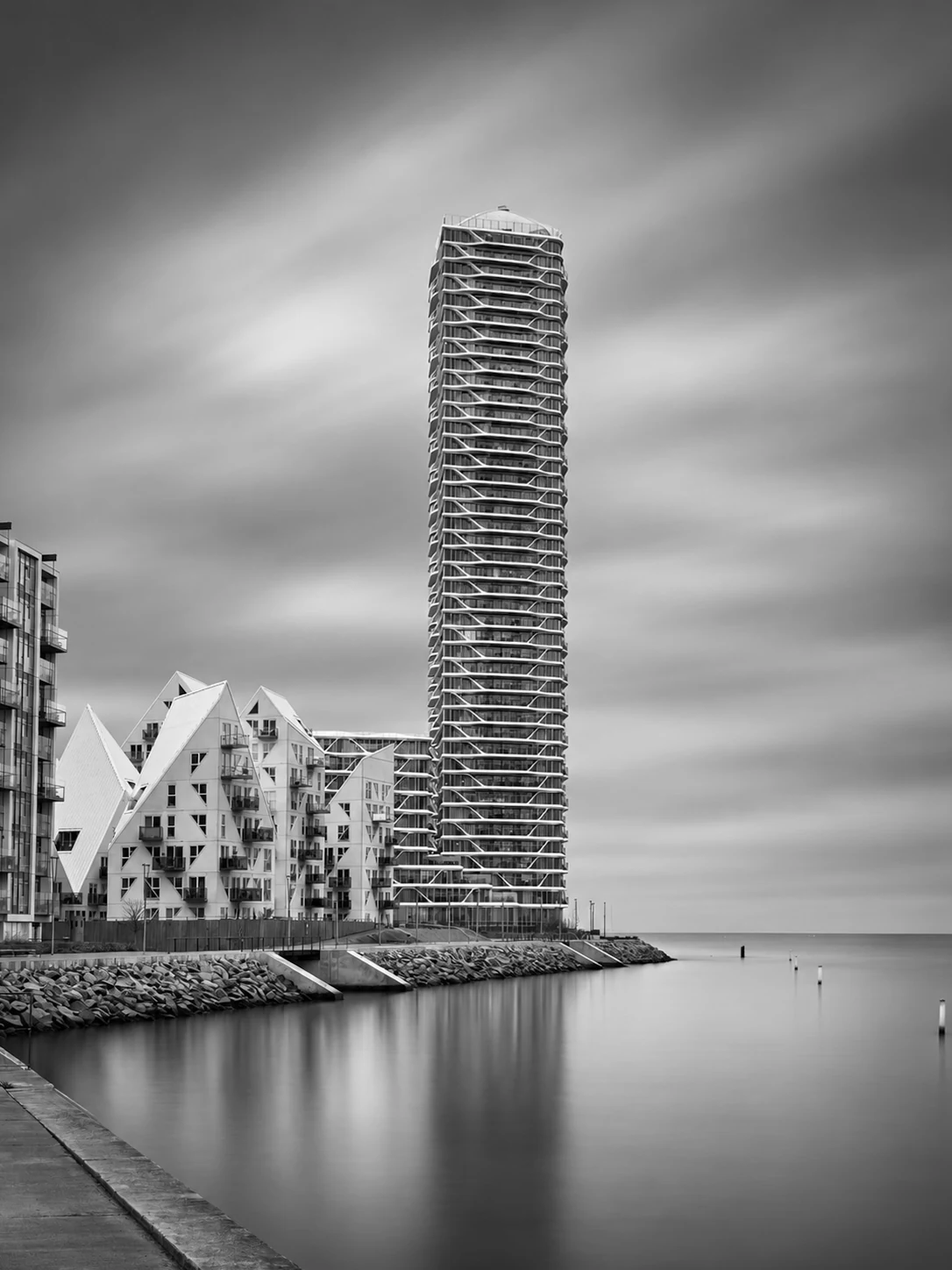
The headline building is the Iceberg, or Isbjerget: a cluster of white apartment blocks whose roofs rise and fall in sharp peaks, like broken ice pushed up against the shore. Beside it stands the Lighthouse, a slender residential tower that climbs far above everything around it, wrapped in fine horizontal bands. Seen from along the quay, the two make an unlikely pair. One is low and jagged, the other smooth and vertical, and both sit reflected in the water of the bay.
In black and white the district makes even more sense. Without colour, the eye goes straight to edges, repeated balconies and the angle of a roofline against a pale sky. Between the blocks, narrow canals run back from the sea, lined with straight quaysides and buildings raised on slim columns. Stand at the end of one and the whole scene lines up on a single vanishing point, with a footbridge across the far end like a full stop.
It is architecture that rewards patience. The same few hundred metres look different every time you change your position by a step or two, and the frames that work best are often the emptiest.

Finding the details
The famous buildings are only part of it. Some of my favourite moments on the trip came from things I had no plan to photograph at all.
Aarhus has two lighthouses, in a sense. One is the tower on Aarhus Ø that everybody points at. The other stands at the end of a concrete pier: a small harbour light, pale below and dark above, with a pair of lamps sticking out from its railing like ears. It is not a landmark. There is graffiti across its base and a rusting chain lying on the quay beside it. But set against an empty horizon and a heavy sky, it became one of the images from the weekend I like most.
That is what walking a city with a camera does. You start noticing bollards, mooring rings, drainage channels, the line where a pavement meets a quayside, the way a building repeats itself in still water. Aarhus is full of these small, quiet compositions, particularly around the harbour, where old industrial fittings sit alongside new public spaces. None of them would make a must-see list. Most of them made the trip.

Why Aarhus works for a weekend
Aarhus suits a short break almost perfectly. There are direct flights from London, the airport bus drops you in the middle of the city, and once you are there everything is close enough that you can see a lot without ever feeling rushed. One night was enough to feel I had properly been somewhere. A longer stay makes room for ARoS, the art museum with the rainbow walkway on its roof, or the old town houses of Den Gamle By.
It also helped that I had not overplanned. I knew roughly what I wanted to see, when the sun would set and how long the walks between areas would take. Everything else was left open, and that space is where the best parts of the weekend happened: a quiet canal between apartment blocks, a small light at the end of a pier, a tall ship moored on the harbour front that I simply could not walk past.
A good plan for a weekend like this is not a timetable. It is a few fixed points, a sense of the geography and enough room for the city to surprise you. (If you want the longer version of that idea, I wrote about planning a city break without trying to do everything.)

Leaving Aarhus
I flew home on the Sunday evening with a camera roll full of grey skies and the slightly annoying feeling that I had only just got started. That is usually the sign of a good weekend.
If you enjoy architecture, photography or simply wandering a city with no fixed agenda, Aarhus is well worth your time. It is calm, easy to get around and full of buildings that look good from almost any angle, in almost any weather. Go in summer for long evenings on the waterfront. Or go in November, as I did, when the grey skies turn the whole city into a study in black and white.
All photographs were originally captured on a Samsung Galaxy S25 Ultra during my visit to Aarhus on 7–8 November 2026 and individually edited in a fine-art monochrome style, incorporating long-exposure effects.