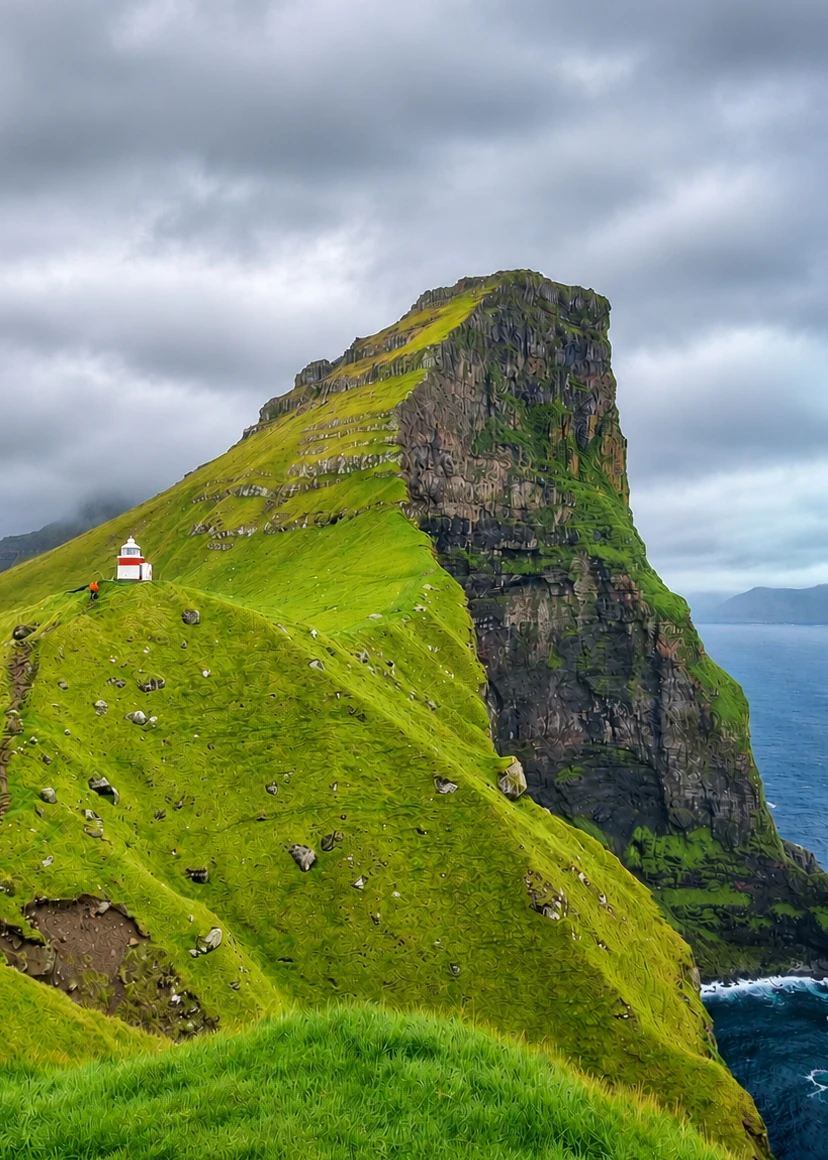
A Lighthouse on the Edge of the World
This is one of my favourite photographs from the trip: a tiny lighthouse perched on a green ridge, with an enormous wall of rock rising behind it. The lighthouse is almost lost in the landscape. That’s precisely what makes the scene so powerful.
There’s something extraordinary about seeing such a small human structure surrounded by mountains, cliffs and the open Atlantic. The grass is intensely green, the rocks are dark and the clouds soften the distant horizons.
The photograph captures something I love about landscape photography. It’s not simply about photographing something beautiful. It’s about showing the relationship between the subject and its surroundings. And in the Faroe Islands, those surroundings are spectacular.
Four nights, a camera and a landscape unlike anywhere else.
There are places you visit, enjoy and eventually forget. And then there are places that stay with you. For me, the Faroe Islands belong firmly in the second category.
In September 2023, I travelled from Edinburgh with Atlantic Airways for four nights in one of the most extraordinary landscapes I’ve ever photographed. Somewhere between Scotland, Iceland and Norway, scattered across the North Atlantic, lies a collection of islands where mountains rise almost vertically from the sea, waterfalls plunge over enormous cliffs and clouds seem to swallow entire landscapes. It’s the sort of place that makes you feel very small. And as a landscape photographer, that’s part of the attraction.
Leaving Scotland Behind
On 14 September 2023, my Atlantic Airways flight departed Edinburgh for Vágar Airport in the Faroe Islands. The scheduled flight time was just one hour and 25 minutes. It’s remarkable that somewhere feeling so remote can be reached in such a short flight from Scotland. But the landscape is another world.
The Faroe Islands aren’t about enormous cities, crowded shopping streets or endless sunshine. They’re about mountains, sea, weather and the extraordinary relationship between them. For a photographer, the possibilities are almost endless.
Where Waterfalls Meet the Atlantic
Few sights capture the character of the Faroe Islands quite like Múlafossur. Near the tiny village of Gásadalur, a waterfall drops directly from the cliffs towards the Atlantic Ocean. Above it, a handful of houses sit beneath enormous mountains that disappear into low cloud. Below, the ocean moves constantly against the dark rock.
It’s one of those landscapes where every element seems perfectly positioned. The waterfall, the cliffs, the village and the mountains all compete for attention. But what makes it special is how they come together.
Looking at my photograph from that trip, it’s the scale that stands out. The little buildings seem almost insignificant beneath the mountains. And the waterfall, dramatic as it is, becomes just one part of something much bigger.

Mountains That Rise From the Sea
One of the remarkable things about the Faroes is how suddenly the landscape changes. A grassy hillside can end in a sheer drop towards the ocean. An apparently peaceful bay can sit beneath enormous rock formations. And a distant mountain might be completely hidden by clouds, only to reveal itself as the weather shifts.
The jagged sea stacks and rocky coastal formations are particularly fascinating. Their shapes are almost architectural, sculpted by natural forces over immense periods of time. For photographers, there are strong lines, unusual silhouettes and wonderful contrasts between the green slopes and dark volcanic rock. Sometimes colour adds to the photograph. Other times, it’s the shape of the landscape that tells the story.

Then there’s Drangarnir, one of those extraordinary coastal formations that almost defies belief. A huge natural arch rises from the Atlantic, with jagged rock formations standing behind it. What struck me was the contrast between the solid, dark rock and the constantly moving ocean beneath. It’s the sort of scene where you could spend hours exploring different compositions, watching the light and weather transform the landscape.

The Scale of Everything
Sometimes the best way to understand a landscape is to include people in the photograph. One of my images shows visitors standing on a grassy clifftop, surrounded by enormous rock faces and the Atlantic Ocean. Without the people, it would still be a dramatic scene. With them, the scale becomes impossible to ignore. Suddenly, the height of the cliff and the size of the mountains become much easier to appreciate.
It’s a reminder that we’re only temporary visitors in places like this. The landscape was here long before us, and it’ll remain long after we’ve gone. There’s something wonderfully humbling about that.

Another photograph from Vágar captures that same extraordinary sense of scale from a completely different perspective. A towering cliff rises almost vertically from the Atlantic, while a lone figure near the top looks almost insignificant against the enormous rock face. It’s one of those scenes where the human element makes the photograph. Without that tiny figure, it’s difficult to appreciate just how immense the landscape really is.

Water, Rock and Movement
Water is everywhere in the Faroe Islands. It falls from mountains, rushes through rocky streams, tumbles over cliffs and crashes against the coastline. One photograph from my trip shows a waterfall dropping into a steep, rocky valley, with smaller cascades making their way between enormous boulders. Another captures waves breaking against a rugged coastline, leaving brilliant white patterns across the deep blue water.
These are completely different scenes, but they share the same character. Movement.
The landscape might appear still, but the water never is. For me, that’s one of the most fascinating things to explore through photography. The contrast between solid rock and constantly moving water creates endless opportunities.


The Light Changes Everything
You don’t visit the Faroe Islands expecting guaranteed blue skies. Cloud, mist and rapidly changing weather are part of the experience. And from a photographic perspective, that’s not necessarily a disadvantage.
Low clouds can make mountains appear more mysterious. Soft light reveals subtle details in grassy slopes. And when warmer light breaks through, even briefly, the landscape can take on an entirely different character.
One of my photographs shows a camera positioned on a tripod overlooking a mountain and winding fjord, with warmer light reaching across the hills. It’s a lovely reminder of why I enjoy landscape photography. Sometimes the reward is simply being somewhere extraordinary with a camera in front of you.

Four Nights, Countless Photographs
My visit lasted from 14 to 18 September 2023. Four nights isn’t enough to see everything the Faroe Islands have to offer. But it was enough to experience their extraordinary landscapes and return with photographs that still mean something to me more than three years later.
And perhaps that’s the point. Travel doesn’t have to be about covering every mile or ticking every attraction off a list. Sometimes it’s about finding a place that speaks to you, giving yourself time to appreciate it and taking something meaningful away from the experience. For me, the Faroe Islands were one of those places.
Why the Faroe Islands Stay With You
It’s difficult to explain the scale of the Faroese landscape through words alone. Photographs help, but even they can’t fully communicate the relationship between the mountains, the ocean and the ever-changing weather. What I can say is that the islands have a character all of their own. Wild, beautiful, dramatic and occasionally almost unreal.
If you love landscapes, walking, photography or simply visiting places that feel different from anywhere else, the Faroe Islands deserve serious consideration. I went in September 2023. And looking back at the photographs, I’m reminded why I wanted to go in the first place.
Some places really do stay with you.
JC | FieldGuide Journeys