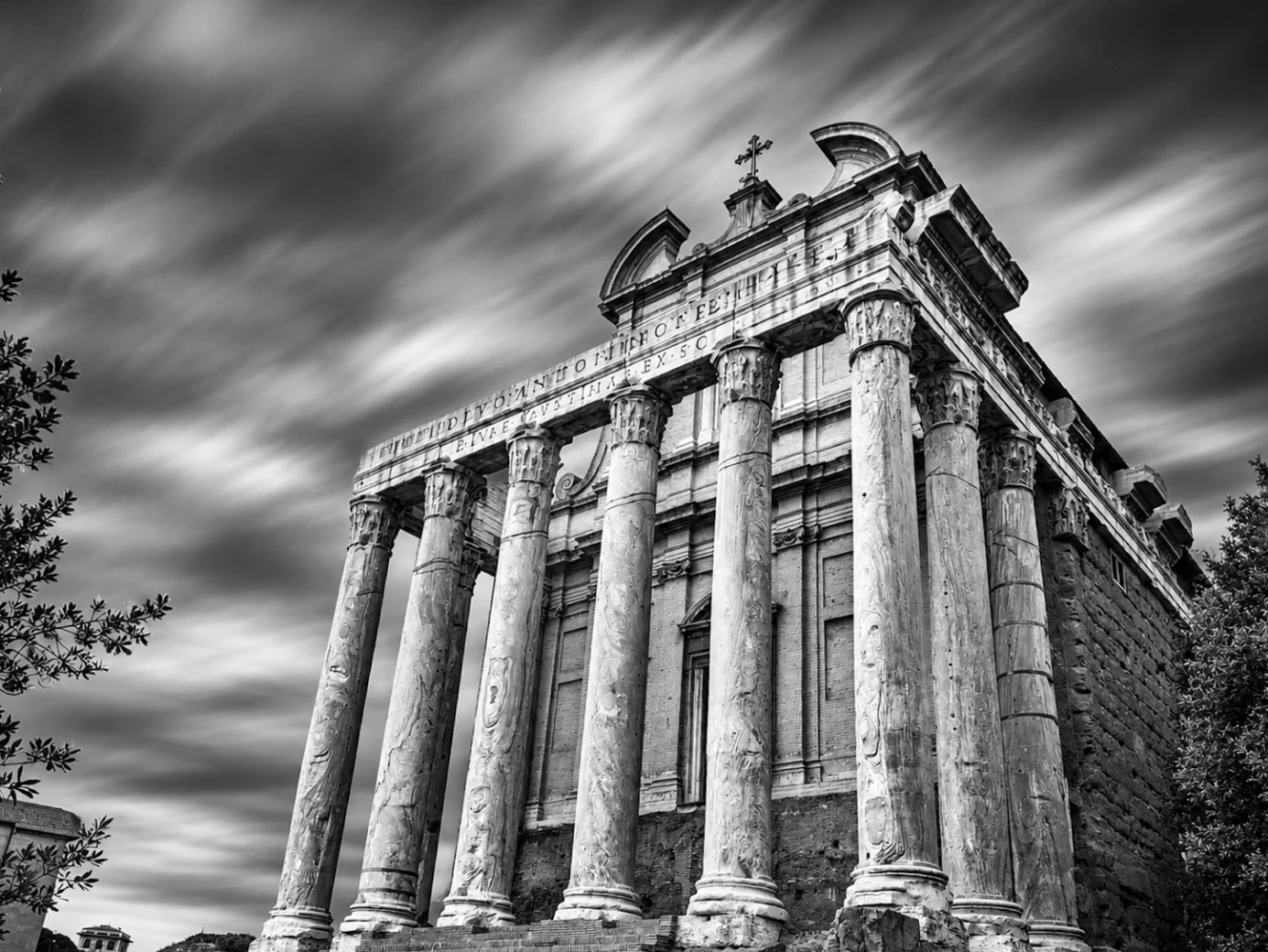
A Temple That Became a Church
Of all the photographs I brought home from Rome, this is the one I return to most. Six great columns of veined marble stand across the front of the Temple of Antoninus and Faustina, still carrying their ancient entablature, and directly behind them rises the Baroque front of a church. Two very different Romes, built more than fourteen centuries apart, share a single frame.
The temple was begun in AD 141 by the emperor Antoninus Pius in honour of his wife, Faustina the Elder, who had been deified after her death. When Antoninus himself died in 161, the temple was rededicated to them both. Centuries later the building became the church of San Lorenzo in Miranda, and in 1602 the church was given the new facade that now rises behind the columns. Being put to a new use is one of the reasons this temple survives so complete, when so much of the Forum around it was stripped for stone.
February, a camera and two thousand years of history.
In February 2024 I spent time in Rome with a camera and a simple aim: to photograph its great monuments in a way that felt timeless. Winter is a good season to try. The crowds are usually lighter than in the summer months, the sun sits lower in the sky and old stone seems to hold more of its texture.
Black and white suits Rome particularly well. Without the warm colours of brick, marble and travertine, the eye goes straight to columns, arches, carved figures and the shapes they make against the sky. The city starts to look less like a busy capital and more like the place in old engravings and photographs that drew travellers here for centuries.
Walking Through the Forum
The Roman Forum was the political, religious and commercial heart of the ancient city. Today it is a valley of broken stone between the Palatine and Capitoline hills, where temples, basilicas and triumphal arches survive as fragments. It can be a confusing place at first. Paths cross at odd angles, foundations overlap and almost nothing stands at its full height.
That is exactly what makes it so rewarding to photograph. A few surviving columns, still holding up a piece of carved entablature, can say more about scale and ambition than a complete building ever could. Isolated against a heavy sky, they look less like ruins and more like a memorial to everything that has gone.

The Colosseum Up Close
Every visitor to Rome eventually stands beneath the Colosseum, and it never quite loses its power. Construction of the Flavian Amphitheatre began under the emperor Vespasian around AD 70, and his son Titus dedicated it in AD 80 with games that are said to have lasted 100 days. It held tens of thousands of spectators, seated in tiers that reflected their place in Roman society.
I wanted a photograph that showed the building as architecture rather than as a postcard. Looking up along the curve of the outer wall, the arches repeat into the distance, each level framed by its own columns, and the stone is pitted and patched by almost two thousand years of weather, earthquakes and reuse. Seen that way, the Colosseum feels less like a monument and more like a vast machine built for crowds.

An Emperor’s Column
A short walk from the Pantheon, in Piazza Colonna, stands a monument that many visitors pass without stopping. The Column of Marcus Aurelius commemorates the emperor, who died in AD 180, and his wars beyond the Danube frontier. A band of carved reliefs winds around the shaft in twenty-one turns, filled with marching soldiers, river crossings, camps and battles.
The figure on top is not the emperor. The original statue, probably of Marcus Aurelius himself, had been lost long before 1589, when Pope Sixtus V had the column restored and crowned with a bronze statue of St Paul. It is a very Roman arrangement: an imperial monument, repaired by a pope, still standing at the centre of a modern capital.

Water From an Ancient Aqueduct
The Trevi Fountain is Baroque theatre on a monumental scale, squeezed into a small square. It marks the end of the Aqua Virgo, an aqueduct completed in 19 BC under Agrippa to bring water into the city. The fountain itself is far later. Nicola Salvi won the commission from Pope Clement XII in 1732, and although Salvi died in 1751, the work was finally completed in 1762.
Photographing it is a challenge. The square is rarely empty and the fountain fills almost every direction you look. A tall, narrow frame helped, running from the sculpted crest at the top, through the columns and statues, down to the water spilling over the rocks into the basin.

At the centre of it all stands Oceanus, carved by Pietro Bracci, striding forward from his niche on a shell-shaped chariot drawn by sea horses and tritons. Up close, the detail is remarkable. The curls of his beard, the folds of his cloak and the stone waves beneath his feet all seem caught in motion. It is easy to treat the fountain as a backdrop for photographs and coins, but spend a few minutes with the sculpture itself and it becomes something else entirely.

A Dome Above the Trees
Rome’s skyline is defined by domes, and none is more famous than St Peter’s. Michelangelo designed it, but he died in 1564, when construction had reached only the drum. Giacomo della Porta and Domenico Fontana completed the vault in 1590, giving it a steeper profile than Michelangelo had planned, and the lantern on top followed in 1593.
My photograph shows the dome rising above dark pines and cedars, with a smaller dome beside it. There is something quietly satisfying about seeing it this way, framed by trees rather than crowds, as one part of a landscape instead of the whole of it.

Echoes of an Empire
What stays with me most is how Rome layers its history rather than replacing it. A temple becomes a church. An emperor’s column is crowned with an apostle. An ancient aqueduct ends in a Baroque fountain. Wherever you stand, two or three different versions of the city are visible at once.
Black and white felt like the right way to show that. Without colour, the centuries blur together a little, and the monuments look as they might in an old engraving: stone, light and shadow, with the sense of time passing over all of it.
If you love history, architecture or photography, Rome rewards every hour you give it. February is a good time to try. The days are shorter, but the city is generally quieter than in the busy summer months, and low winter light is kind to old stone.
JC | FieldGuide Journeys